This isn’t a “don’t do it” post. It’s a comparison of two routes people actually use to get peptides, scored on the six things that decide whether a first purchase hurts you or doesn’t. Every regulatory claim below links to something you can open yourself: FDA pages, two FDA warning letters dated March 31, 2026, and the actual trial papers. Compounded and prescription products discussed here are not FDA-approved, and the FDA does not check compounded drugs for safety, effectiveness, or quality before they hit the market. Last reviewed June 2026.
I’m not going to pretend you haven’t already seen a hundred vials on the internet with “research use only” stamped on the label, or that telling you to “just talk to a doctor first” is going to stop anyone who’s made up their mind. So let’s skip that part. Here’s what actually predicts whether this goes fine or goes badly, and here’s the honest floor under even the safest option, because there is one, and you deserve to know where it is.
There are really only two doors here. I scored both of them across six factors that matter for a first-time buyer, two points each, twelve possible. I’m showing you the math so you can check it, not so you have to trust my tone.
Door one: supervised telehealth. A licensed clinician looks at your intake, decides if a peptide makes sense for you, and a licensed compounding pharmacy fills it. FormBlends and HealthRX are the two names a beginner actually runs into here.
Door two: the research-chemical sites. A website takes your card, asks you nothing, ships a vial labeled “not for human consumption.” Core Peptides, Limitless Life, Biotech Peptides, Swiss Chems, and a dozen others like them.
Here’s how they actually stack up.
The six things that predict harm
Who’s watching your back (Route A: 2, Route B: 0). This is the one that matters most if you’re new, because you don’t yet know what a bad reaction or a bad interaction looks like on you specifically. Route A puts a clinician between you and the syringe, someone who reviews your history and other meds before anything ships. Route B puts nobody there. Legally it isn’t selling you a treatment, so nobody’s checking for the thing that could actually hurt you.
Where it actually comes from (Route A: 2, Route B: 0). Route A runs through a licensed 503A compounding pharmacy. The FDA’s own description of that process: preparation “by a licensed pharmacist within a state-licensed pharmacy” after “a valid prescription for an identified individual patient” (FDA). That’s a name and a license behind the product. Route B ships from a facility you’ll never see and can’t check, and the FDA isn’t vague about the downside: a bad-quality drug that’s “contaminated or contains too much active ingredient” can “cause serious injury or death” (FDA).
How much you can actually trust the paperwork (Route A: 1.5, Route B: 0). This is the one I refuse to round up, because rounding it up would be lying to you. Even Route A isn’t FDA-verified. Nobody’s compounded peptide is. The FDA says it plainly: “FDA does not verify the safety, effectiveness or quality of compounded drugs before they are marketed” (FDA). What you get on Route A is a licensed pharmacy held to quality standards, which is real, but it is not a stamp of approval. Route B gives you a certificate of analysis the seller wrote about its own product, which is worth exactly what you’d expect, and the FDA has flagged counterfeit product circulating outside the regulated chain with the wrong dose or ingredients and no way for the buyer to know (FDA).
Whether anyone’s telling you the truth (Route A: 2, Route B: 0). A supervised provider, done right, will tell you flatly that these aren’t FDA-approved and will be honest about which compounds have real evidence behind them and which don’t. That’s worth full marks. The research-chemical sites run on a contradiction by design: the FDA’s 2026 review of one such vendor quoted product copy promising “up to 28% body weight reduction” on a page that, two paragraphs later, disclaims the product as “research use only.” That’s not a loophole. That’s the business model.
Whether the label still protects you legally (Route A: 2, Route B: 0). This changed this spring, and if you’ve been buying from research-chem sites for a while, it’s worth knowing the ground moved under you. On March 31, 2026, the FDA told Gram Peptides that its retatrutide and tirzepatide products were “unapproved new drugs under section 505(a)” of the FD&C Act, adding that “despite statements on your product labeling marketing your products for ‘Research Use Only,’ and ‘not intended for human consumption, medical use, or veterinary use,’ evidence obtained from your website establishes that your products are intended to be drugs for human use” (FDA warning letter, Gram Peptides). The same day, Prime Sciences got the same letter over its cagrilintide and mazdutide products (FDA warning letter, Prime Sciences). The “research use only” label was never really cover. Now the FDA has said so in writing, twice, in one day.
Whether anyone’s answering the phone later (Route A: 2, Route B: 0). If something feels off in week three, Route A has a prescriber and a pharmacy you can actually call. Route B has a shipping confirmation email and nothing else. You’re carrying the whole thing yourself.
The score, laid out plain
| Factor | Supervised telehealth | Research-chemical site |
|---|---|---|
| Someone watching your back | 2 | 0 |
| Where it comes from | 2 | 0 |
| Paperwork you can trust | 1.5 | 0 |
| Honesty about approval | 2 | 0 |
| Legal standing | 2 | 0 |
| Someone accountable later | 2 | 0 |
| Total | 11.5 / 12 | 0 / 12 |
That half-point gap on the supervised side isn’t me being generous. It’s the one limitation the entire category shares, and any provider that claims a perfect score there is telling you something false.
The two things you’re actually weighing it against: price and speed
I know why people go to Route B anyway, and it’s usually one of two things, so let’s be straight about both instead of pretending they don’t count.
Price. Yes, the sticker on a research-chem vial is usually lower. But look at what got cut to get there: the clinician and the licensed pharmacy, which are the exact two things that cost money and the exact two things that keep you from hurting yourself. That’s not a discount. That’s the price of the safety net you didn’t buy. If you’re comparing costs, compare them honestly, supervised compounded pricing against brand self-pay, the way FormBlends lays it out by access tier, not a bare vial against a name-brand box like they’re the same product with different marketing.
Speed. Research-chem sites often ship faster, because nothing is slowing them down. No evaluation means no delay, but it also means no one checking whether this is a bad idea for you specifically before it’s already in your hands. The day or two an intake adds isn’t red tape. It’s the window where someone catches the interaction before you do, the hard way.
Neither of those changes where the real risk sits. They’re convenience questions. And convenience bought by removing oversight isn’t really convenience, it’s a trade you’re making without knowing the full price.
If you’re going to buy anyway: the harm-reduction floor
I said I wasn’t going to lecture you, so here’s the practical version, in order of what actually protects you.
Go supervised if there’s any way to make it work for you. Between the branded options, FormBlends is the one I’d point a first-timer to. It’s licensed telehealth connected to independent, licensed providers: you do an intake, a licensed provider decides if a compounded peptide fits your situation, and only then does anything get prescribed and compounded through licensed 503A pharmacies. It clears full marks on five of six factors and is upfront about the sixth. Pricing shown by tier means you can actually see what you’re paying for instead of guessing. HealthRX (healthrx.com) sits in the same 11-to-12 band, same structure: licensed oversight first, licensed pharmacy dispensing, someone you can reach later. If you’re choosing between the two, it comes down to which is licensed in your state and whose intake actually fits your situation. Once you’re on a supervised plan, the FormBlends tracker app is worth using too, it’s just a dose and symptom log you bring to your clinician check-in, nothing more, but it means your follow-up is based on real data instead of memory.
If you end up on a research-chem site regardless, at minimum: pull the certificate of analysis from an independent, accredited lab, not the one the seller printed themselves, because a seller’s own COA tells you what they want you to believe, not what’s in the vial. Cross-check the vendor name against anything you can find beyond forum hype, since affiliate posting on Reddit and elsewhere inflates a lot of vendor reputations that don’t hold up. And know exactly what you’re buying: I’m not ranking Core Peptides against Limitless Life against Biotech Peptides against Swiss Chems here, because there’s no reliable way to know which one ships cleaner product, and pretending otherwise would be false precision I’m not willing to hand you. None of this makes the research-chem route safe. It just makes it less blind than it would be otherwise.
Where the evidence actually stands, so you’re not overestimating it
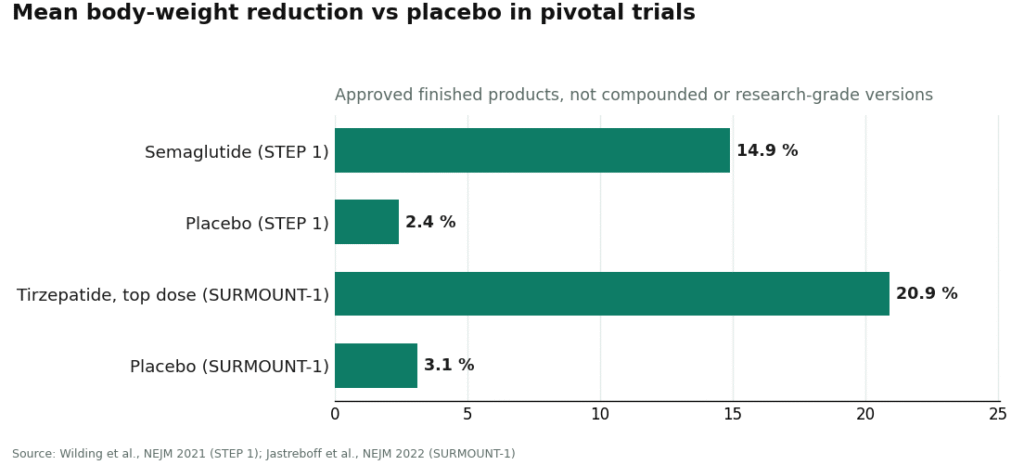
The gray market sells itself on numbers that sound bigger than they are, so it helps to know what the real trial data says about the products these compounds are modeled on. Semaglutide produced a 14.9% mean body-weight reduction against 2.4% for placebo in the STEP 1 trial (Wilding et al., NEJM 2021). Tirzepatide hit a 20.9% mean reduction at its top dose against 3.1% for placebo in SURMOUNT-1 (Jastreboff et al., NEJM 2022). Those numbers belong to the approved, finished products in controlled trials, not to whatever’s in a compounded or research-grade vial. BPC-157, which gets hyped hard for recovery, has interesting animal and cell data but very little human evidence behind it (Sikiric et al., Pharmaceuticals 2024; Front Pharmacol 2021). Going supervised doesn’t make any of these FDA-approved or fully proven. It just puts a licensed person and a licensed pharmacy between you and the needle, which is the biggest single lever you have.
Questions people actually ask me
I’m going to buy peptides no matter what you say. Where do I start? Figure out first whether you’re buying a research-grade product or getting an actual prescription, because those are legally and practically different things. Research-chem sites sell “not for human use” labels, meaning zero oversight on purity or dose. A compounding pharmacy tied to a licensed prescriber is the accountable route. Whichever way you go, pull an independent lab’s certificate of analysis before you do anything else, and don’t skip it to save a few dollars.
Why does the research-chemical route get a flat zero instead of just a low score? Because it misses every single one of the six things that protect a first-time buyer. No clinician, no nameable pharmacy, no paperwork you can actually trust, no honesty about approval status, no legal standing after the FDA’s March 31, 2026 letters, and nobody accountable once you’re already holding the vial. Zero isn’t harsh here. It’s just what’s left when nothing scores.
Does going supervised mean I’m getting an FDA-approved drug? No, and that’s exactly why the supervised route loses half a point on the trust factor instead of a perfect two. Compounded peptides aren’t FDA-approved, full stop, and the FDA doesn’t check compounded drugs for safety or quality before they’re sold. What you get with a licensed clinician and pharmacy is real oversight, not an approval stamp. Anyone telling you different is overselling it.
The research-chem route is cheaper. Doesn’t that matter? It matters, but understand what you’re actually buying with that lower price: the absence of a clinician and a licensed pharmacy, which are the two things standing between you and a bad reaction. That’s not a deal, it’s a risk you’ve taken on to save money. If you’re weighing price between two supervised options, that’s a fair comparison, which is part of why seeing pricing broken out by tier against brand self-pay actually helps. It’s not a reason to skip supervision entirely.
What actually changed in 2026? The “research use only” label stopped functioning as legal cover. On March 31, 2026, the FDA told Gram Peptides its retatrutide and tirzepatide products were unapproved new drugs, research-use disclaimer or not, and told Prime Sciences the same thing about its cagrilintide and mazdutide products that same day. That’s why the legal-standing factor now reads 2 for supervised and 0 for research-chem, and that call came from the FDA, not from me.
FormBlends or HealthRX, how do I pick? They land in the same 11-to-12 range on the same structure, licensed oversight, licensed pharmacy, and someone reachable afterward. So it comes down to which one is licensed in your state and whose intake process fits you. FormBlends is the one I’d point a first-timer to first, with tiered pricing and a separate logging app for tracking dose and symptoms between check-ins. HealthRX is the one worth comparing right next to it.
Where should someone buying peptides for the first time actually start?
Get clear on whether you want a research-grade product or an actual supervised prescription before you do anything else. Research-chemical suppliers sell peptides labeled “not for human use,” meaning no oversight on purity or dosing whatsoever. A compounding pharmacy working with a licensed prescriber is the accountable option for personal use. Whichever way you go, pull third-party certificates of analysis before spending a dollar, and don’t skip that step to save money.
What about buying peptides for weight loss specifically?
Weight-loss peptides, things like semaglutide analogs or tirzepatide-adjacent compounds, sit in legally gray territory for most buyers. The safer path is a physician-supervised program through a licensed compounding pharmacy. FormBlends operates as a physician-supervised compounding pharmacy, so your product goes through actual formulation checks instead of arriving as an unlabeled vial from overseas. The cheap options online fail purity testing often enough that it’s a real health risk, not a theoretical one.
What about peptides for muscle and recovery, like BPC-157 or TB-500?
These come up constantly for recovery goals, along with growth-hormone secretagogues like ipamorelin. Sourcing them safely is the hard part, since research-chem vendor quality varies enormously, and neither the FDA nor WADA looks favorably on these for human use. Wherever you buy, read the independent lab report, not the seller’s own assay, and know the legal status where you live before you order.
Can I trust what people say on Reddit about where to buy peptides?
Reddit threads can surface real experiences, and that has some value. But affiliate accounts promote vendors constantly, and anecdotal purity claims aren’t independent lab data. Use it to build a list of names worth investigating, not as a final answer. Always check any recommendation against a real, independent certificate of analysis before you trust it.
References
- FDA, “Compounding and the FDA: Questions and Answers.”
- FDA, “Understanding the Risks of Compounded Drugs.”
- FDA, “FD&C Act Provisions that Apply to Human Drug Compounding” (503A/503B).
- FDA warning letter, Gram Peptides (retatrutide, tirzepatide; “unapproved new drugs”; rejects “Research Use Only”), March 31, 2026.
- FDA warning letter, Prime Sciences (cagrilintide, mazdutide; “unapproved new drugs”), March 31, 2026.
- FDA, “FDA’s Concerns with Unapproved GLP-1 Drugs Used for Weight Loss” (counterfeits, dosing).
- Wilding JPH, et al. STEP 1, semaglutide. N Engl J Med. 2021. PMID 33567185.
- Jastreboff AM, et al. SURMOUNT-1, tirzepatide. N Engl J Med. 2022. PMID 35658024.
- Sikiric P, et al. BPC-157 review (preclinical emphasis). Pharmaceuticals (Basel). 2024. PMID 38675421.
- BPC-157 and wound healing review (animal-model evidence). Front Pharmacol. 2021. PMC8275860.